
The Four Roles that support Gifted Development
Working with the gifted can be many things but dull certainly isn’t one of them. They differ so much from each other with widely different biographies, while at the same time sharing certain giftedness specifics, that no two developmental trajectories are the same. The work is complex and I regularly find myself in different roles in relation to the client. This depends heavily on where the client is at a certain stage in the process and sometimes even within one sitting. Also, the process itself is never linear. All this requires flexibility, meta-awareness and a specific skill set of the giftedness practitioner.
In this blog I delve into the roles I see as relevant when supporting gifted individuals in actively shaping their lives and careers and why as a practitioner it is useful to be aware of them. There are four in total of which one is foundational. I make a case that for working with gifted adults, mentoring is the stabilising undercurrent that enables the rest. Finally, I explain why in light of the four roles we at Your Evolving Self have chosen to work with gifted practitioners that also have a seperate profession next to providing gifted support.
The Four Roles in Giftedness Support
Gifted adults searching for career direction often arrive at the same frustrating intersection: brilliant potential on paper, yet stalled progress in practice. They have ideas, capability, creativity, a wide range of possibilitiies but struggle to translate that inner landscape into an outer career. That’s why a fair part of them starts looking for giftedness support: to give them a sense of direction and the tools to venture successfully on their path.
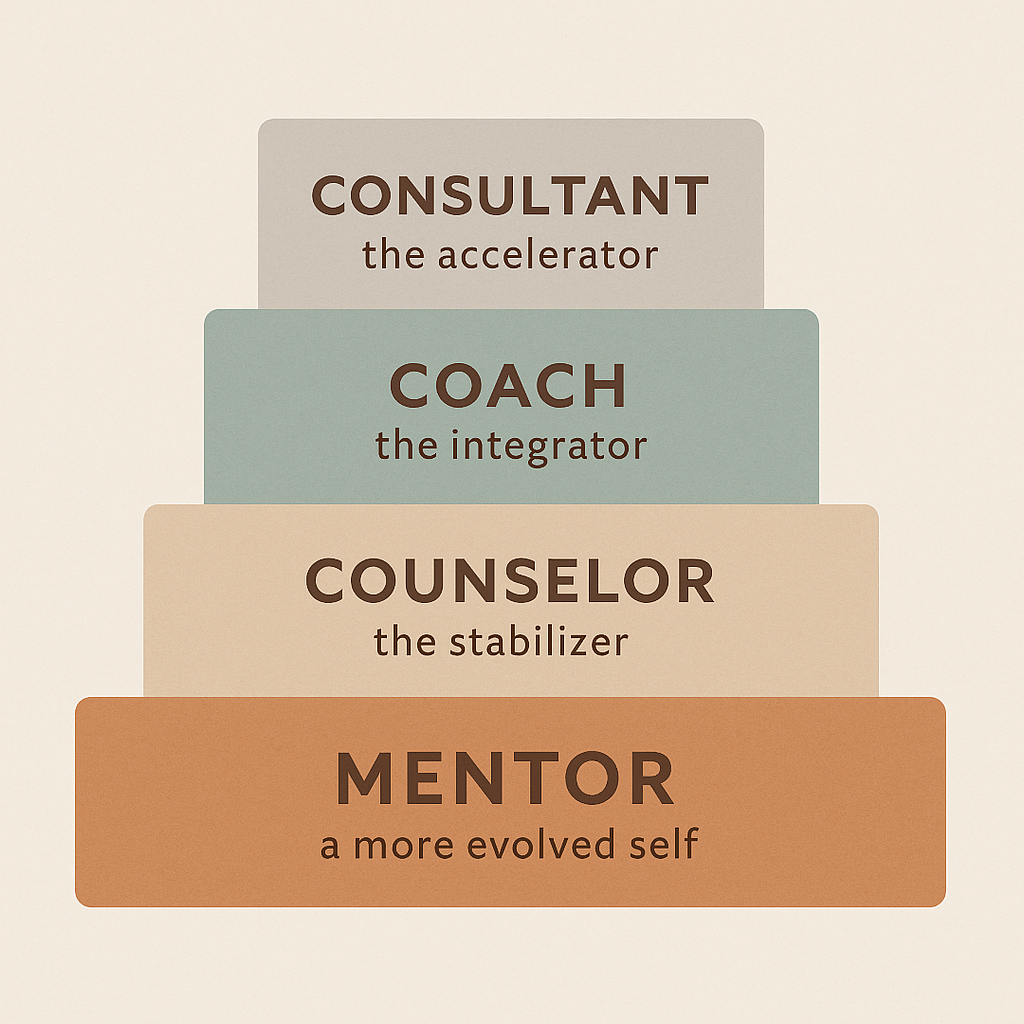
Four Roles of Gifted Support by Dirk Anton van Mulligen, 2025.
The thing is, giftedness is non-linear in more ways than one. It is spiraled, layered, volatile, intuitive, implosive or explosive, its direct opposite. And occasionally giftedness presents itself chaotic, but always potent. A conventional career guidance professional can easily mistake potential for noise, intensity for pathology, speed for recklessness, things that need to be fixed or at least toned down. They respond to their client with the best tools they have and to the best of their abilities, but these are often the wrong tools for this specific mind.
Gifted adults are no blank slates, you’re not working with a Tabula Rasa. They often come with a lifetime of experiences; experiences that have left their marks in more ways than one, from beliefs and emotions to imprints on their nervous system.
If we want gifted individuals to thrive, we must distinguish four fundamentally different support roles, and understand what each does and does not do. Because gifted individuals don’t need generic advice; they need the right kind of guidance, at the right developmental tier, delivered by a practitioner who can meet them at their level.
1. The Mentor — the evolved self, the embodied possibility
Imagine standing at the foot of a mountain. You can study maps, analyze paths, read books on giftedness yet nothing substitutes the presence of someone who has stood where you stand, climbed where you intend to climb, and integrated the terrain into their very being.
A mentor is not merely skilled,
A mentor embodies the destination.
This role forms the base layer in gifted development work. Not because mentoring comes first chronologically, but because it provides the psychological precondition for every other role to be effective: trust, respect, and resonance. In the gifted context, mentoring is not an optional add-on. It is the psychological anchor that makes the other forms of support viable.
A mentor:
Embodies the trajectory the gifted client wants to be on.
Functions as living evidence that the path is real and attainable.
Provides early-stage confidence: “If someone who is like me could get there, so can I.”
Acts as the constant reminder of the client’s Why: the payoff, the purpose, the horizon.
Offers tacit knowledge, attitude, stance and worldview that cannot be taught through technique.
Resonates at identity level, generating trust and motivation before any structured work begins.
The mentor is the undercurrent that gives direction, meaning and credibility to the entire process. The other three roles stack on top of this.
2. The Coach — The mirror that helps Turn Potential Into Agency
Once trust in process, feasibility and practitioner exists, the gifted mind requires a counterpart who can track speed, complexity and abstraction without drowning. This is the Coach, whose task is not to give answers, but to draw them out. And to function as a mirror that enables the clients to see themselves. Here some form of assessment or analysis usually very useful.
Where the mentor provides perspective, the coach enables self-authorship. The coach listens, challenges and reflects, without shrinking complexity into something convenient. Many gifted individuals have been told to slow down, tone down, fit in. The good coach does the opposite: they meet the client at altitude and guide them in organizing their clouds into weather. Once the mentor bond creates trust and direction, the coach helps the gifted client articulate, structure and refine what is already inside them.
A coach:
Works with identity formation, decision-making, patterns, alignment and strategy.
Helps overcome internal contradictions and integrate their complexity.
Give an overview of their gifted persona.
Builds autonomy and self-authorship.
Gives practical tools to empower, self-manage and help avoid pitfalls
The coach helps the client to recognize themselves and navigate their own complexity, as well as challenges in the world outside.

Four Roles of Gifted Support by Dirk Anton van Mulligen, 2025.
3. The Counselor — stabilising emotional turbulence so growth can take hold
Giftedness burns bright and sometimes burns. Misattunement, sensitivity, overexcitability, existential anxiety, rejection, shame of “too much” and especially unjustified shame of “not having anything to show for all my potential” are all experiences that live in the nervous system. Many gifted adults are not derailed by incompetence but by internal tension and friction.
A counselor works not on ambition, but on safety. They do not work on strategy, but on healing and wholing. This is where wounds are named, deep fears and feelings of inadequacy are shared. Intensity regulated. Old narratives dissolved. It is not therapy but it acknowledges the emotional weight that giftedness carries. Without stability, strategy becomes fantasy. Without self-acceptance, potential becomes pressure.
For many gifted adults, emotional intensity, misattunement or perfectionistic patterns create drag on development.
A counselor works on the emotional groundwork by:
Reducing friction.
Healing chronic patterns.
Creating internal safety.
Allowing the cognitive engine to run without overload.
A counselor helps clients to accept themselves, to feel safe.
4. The Consultant — The accelerator translating general into strategic direction
Now that identity is anchored and internal turbulence lowered, we reach a sometimes missing or misunderstood role: the Consultant. This is the one who looks outward. Where coaching explores potential, the consultant turns it into professional positioning. Where mentoring inspires and counseling stabilizes, consulting executes.
The consultant distills complexity into pathways, markets, opportunities. They do not ask “Who are you?”. Instead they ask “Where does this updated version of you go next?” They build structure, frameworks, and blueprints. They accelerate movement. Armed with specific domain expertise a consultant:
Provides actionable paths, frameworks, diagnostics and labour-market insight.
Maps the gifted profile onto real-world opportunities.
Simplifies complexity without oversimplifying the person.
Accelerates strategic progress.
A consultant helps clients make actual progress on their path.
Why mentoring matters most

Photo by Remy Gieling on Unsplash
First a quick recap. Gifted individuals are notoriously difficult to guide because:
They think in non-linear patterns.
They detect incompetence and inauthenticity immediately.
They mistrust authority unless it is earned through demonstrated depth.
They need to see an attainable version of themselves in the person they follow.
The mentor function of embodied mastery, integrity & perspective is what unlocks the entire developmental process. Without a mentor-level resonance, coaching feels empty, counseling feels irrelevant, and consulting feels superficial. With it, everything else becomes exponentially more effective.
A mentor should NOT be a guru of some sorts. That creates an unhealthy dynamic within the context of career and life development. A mentor is more Obi-Wan Kenobi than Yoda. More similar, more attainable.
Although teaching gifted children falls outside the scope of this blog, I do want to mention that to my mind when working with highly and exceptionally gifted children, the mentor role is equally as important as it is for gifted adults.
Gifted clients do not need someone impressive or overly charismatic.
They need someone settled, coherent, and unmoved by complexity.
Mentor presence is the art of becoming a stable reference point
in a world that constantly distracts or even pulls gifted minds apart.
how can you use this disctinction in roles?
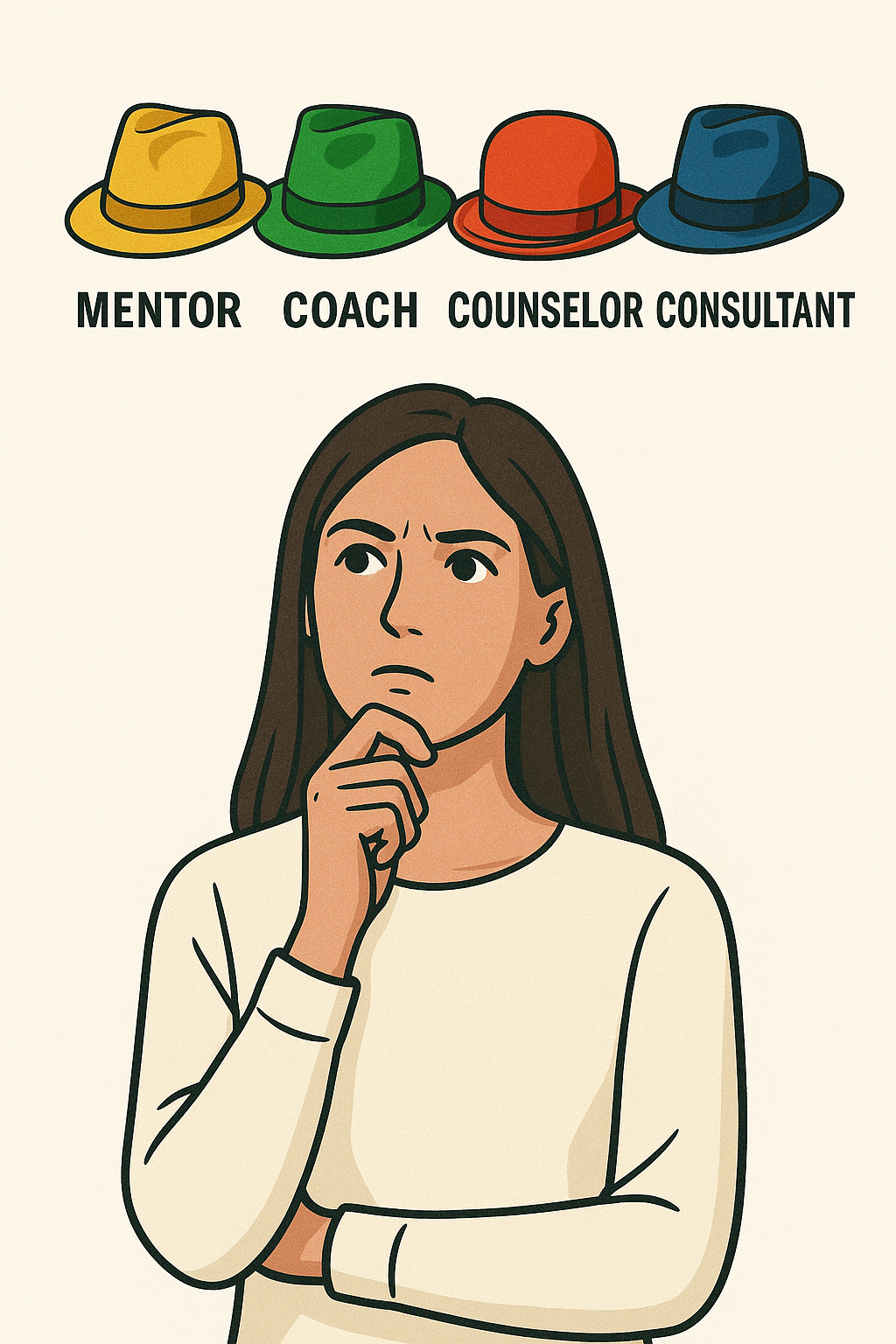
For the giftedness practitioner, being consciously aware of the four roles is not a theoretical exercise. It is a practical navigational tool, much like Edward de Bono’s Thinking Hats. Each role represents a distinct lens, a different kind of intervention, and a separate developmental function.
By deliberately checking in with oneself — Which role is needed right now? Which hat should I be wearing at this exact moment? — the practitioner prevents unconscious blending, overreliance on one mode, or drifting into personal preference rather than client need.
This awareness becomes especially critical when a session hits a lull, when the client seems stuck, or when momentum quietly evaporates. Instead of pushing harder in the wrong role, the practitioner can shift intentionally: from consultant to coach, from counselor to mentor, from mentor back to strategist.
The ability to pivot cleanly restores movement, preserves coherence, and keeps the developmental arc alive.
Or Do you need four separate practitioners?
While it is certainly possible and in many conventional settings even common practice to distribute the four roles across four separate professionals (a mentor for direction, a coach for growth, a counselor for emotional grounding, a consultant for strategy), something crucial goes missing when the work is fragmented: a unifying meta-layer of integration.
Each expert may deliver value within their silo, yet no one holds the entire arc, no one holds overview. The client becomes the project manager of their own development: switching rooms and practitioners, shifting frameworks, translating themselves repeatedly. Insights get lost in the handover and that comes with consequences:
emotional breakthroughs may never reach strategy,
strategic decisions may never integrate into identity and
inspiration may never convert into execution.
Only when all four roles reside in one practitioner who is capable of weaving them moment-to-moment, does the client experience a developmental flow, where every layer informs the next. Integration stops being an aspiration and becomes a lived experience. To be able to this requires something gifted individuals in generally excel at: meta-awareness, complex problem solving, multi-level observation and analysis and the ability to readily pivot and shift between roles. Giftedness in the practitioner also gives substance to the mentor role, it enhances their authority in this respect.
Our take on this
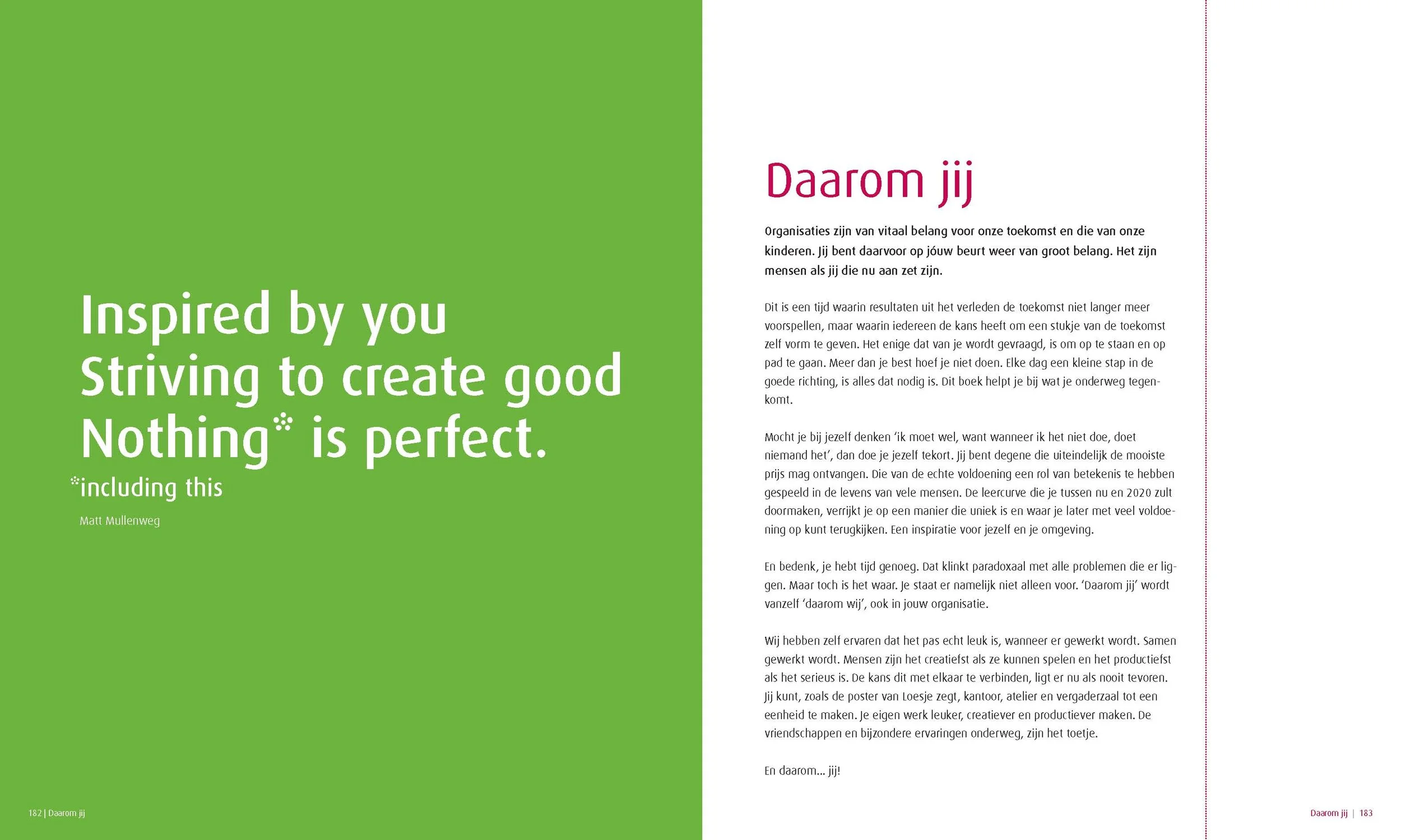
Uit: Geef je organisatie toekomst, een roadmap voor bouwers aan toekomstbestendige organisaties. © Kim Castenmiller en Dirk Anton van Mulligen, 2012.
This is why we at Your Evolving Self explicitly work with seasoned practitioners that are gifted themselves, some also parent of gifted children, and that had to carve out their own paths in life. And who each possess a distinct domain expertise (e.g. education, leadership development, organizational change) that is relevant for the consultancy role. And who also have an occupation next to giftedness development; a second professional leg that greatly adds to see things from a different perspective and a wider view. We aim to achieve sustainable development, to help our clients to Evolve their Selves.
Are we perfect at this? No. We’ve learned to blend our perfectionism with realism. But we always strive to create good as the Haiku says!
Dirk Anton van Mulligen
Your Evolving Self — exploring giftedness, development, and the art of guiding exceptional minds.
© Dirk Anton van Mulligen, Your Evolving Self, 2025.
Please note: This article is the result of regular and long reflection on this matter, supplemented with my experiences with gifted people. In other words, I put a lot of time and energy into it. No part of this article may therefore be reproduced without acknowledging the source and author. If you want to use more than a single quote or insight, please contact me for permission.
