
High+ Giftedness: Marching to a different drum
Why the highest levels of giftedness require different terrain,
not merely more challenge

Marching to a different drum
To do something, act, or behave in a manner that does not conform to the standard, prevalent, or popular societal norm.
Several years ago, I wrote openly about my own experience of (High+) giftedness as both a blessing and a burden. What surprised me was not only the amount of recognition the article received, but also the kind of people who found their way to Your Evolving Self afterwards.
Many of them were not merely gifted in the usual sense. They showed a level of complexity, speed, intensity, alienation, autonomy and inner pressure that pointed to something more specific. Some had formal IQ test results. Many did not. But in conversation, the pattern was often unmistakable:
They were not just quicker thinkers, they were operating from a different inner architecture.
For this group I increasingly use the term High+ Giftedness. Not as a formal diagnostic category, not as a badge of superiority, and not as a way to create yet another rigid label. I use it as a practical, developmental and phenomenological term for those gifted people whose cognitive, emotional and existential intensity moves beyond what most educational, psychological and professional systems are designed to recognize.
The point is not to admire them or put them on a pedestal. The point is to understand them accurately enough to work with them because when we fail to do that, we often offer them exactly the wrong solution: More challenge. More assignments. More explanation. More adaptation. More coaching. More patience. More social skills- and executive function training.
But many High+ Gifted people do not primarily need more challenge or training. They need different terrain.
“The Total Operating Environment in which the High+ Gifted person is expected to learn, work, relate, create, decide and develop.”
Why distinctions matter
There is a well-intended idea that every person is special, every child is talented, and every professional has unique potential. On a moral level, this is attractive. On a practical level, it can become disastrous. Because when everybody is special in the same way, nobody is seen in their actual specificity.
A gifted child does not have the same developmental needs as an average child. A profoundly fast, associative, existentially intense adult does not have the same career questions as a bright, ambitious professional who simply needs more responsibility. A High+ Gifted person may not be blocked because the task is too easy, but because the entire system in which the task is embedded is too narrow, too slow, too fragmented or too unconscious.
Naming difference is not exclusion. It is often the first condition for real inclusion. The paradox is that classification, when used wisely, can help us see the individual more clearly. A label should never become a cage. But refusing to name a meaningful difference often creates another cage: the cage of misrecognition.
You can only pick up a person from where they are, a prerequisite for all teaching, coaching and career development, when you are willing to look closely enough at where they actually are. And who they are in the first place.
That applies to children. It applies to students. It applies to professionals. And it certainly applies to High+ Gifted adults who have spent decades adapting themselves to systems that never truly understood the architecture of their minds.
More than “even more gifted”
In popular language, giftedness is often reduced to “being smarter than average.” That is too flat. Of course, there is a quantitative dimension to giftedness. Someone with an IQ around 145, 160 or higher is not simply a slightly faster version of someone with an IQ around 130. The difference can be substantial. But the more important issue is not only quantitative. It is qualitative.
At higher levels of giftedness, the mind often begins to operate differently. Not only faster, but more systemically. Not only more abstractly, but more (multi)dimensionally. Not only with more information, but with more context, more pattern recognition, more meta-reflection and more simultaneous awareness. This is why High+ Gifted people can be so difficult to understand from the outside. Their thinking may appear chaotic, excessive, restless or impossible to follow. But very often there is structure. It is simply not a linear structure.
A very intelligent linear mind may look for the next piece of the puzzle; fast, razor-sharp and accurate.
A High+ Gifted mind may simultaneously scan the underlying pattern, the exception to the pattern, the hidden assumption behind the pattern, the historical origin of the assumption, the emotional charge in the room, the likely future consequence, and the philosophical flaw in the question itself.
To the outside observer, this can look like overthinking. Or being all over the place. From the inside, it is often just thinking. Or being yourself. Being wired this way creates differentiation from ‘regular’ giftedness in a few ways.
1. Cognitive complexity: not harder tasks, but deeper architecture
A gifted person may think quickly, abstractly and creatively. They often benefit from compacting, enrichment, acceleration or more complex material. A High+ Gifted person often needs something else. They need room to investigate the underlying architecture of the material itself.
They may not ask, “What is the answer?” They may ask, “Why is this even considered a relevant question?”
They may not ask, “How do I solve this problem?” They may ask, “What worldview produced this problem in the first place?”
They may not ask, “What is the correct model?” They may ask, “What does this model exclude in order to remain coherent?”

Photographer as yet unknown. Is this yours? Please let me know so I can either place your credits here or remove the picture.
This is why standard enrichment can fail. Giving a High+ Gifted child or adult more difficult tasks within the same narrow frame may not create engagement. It may intensify frustration. They do not necessarily need a harder maze. They may need permission to redesign the maze, question the need for a maze, or leave the maze entirely and build a map of the territory as they perceive it.
Their preferred learning style is often non-linear, associative, recursive and self-directed. Insights may arrive through sideways movement. A comparison from an unrelated domain. A sudden synthesis. A pattern seen from above rather than built step-by-step from below.
This can be difficult for teachers, coaches, managers and even partners, parents and therapists. The High+ Gifted person may appear to jump. But from their own perspective, the jump is not random. It is the visible endpoint of a hidden internal route. You do not have to understand every association immediately. But you do need to respect that there may be a structure beneath the apparent detour. That is where the real work begins.
2. Social experience: from difference to alienation

Image via www.unsplash.com
Many gifted people feel different. They may feel quicker, more sensitive, more curious or less conventional than the people around them. Still, with some luck, they can often find peers, teachers, colleagues or friends with whom there is enough mutual recognition. For High+ Gifted people, the experience can be more radical.
They may not merely feel different. They may feel alien. Not “I am a bit unusual.” But: “I seem to have landed on the wrong planet.”
This is not drama. It is often the social consequence of a real developmental and cognitive distance. Even within gifted groups, a High+ Gifted person may not easily find someone who thinks, feels, imagines and questions at a comparable level of complexity and intensity. And when they do, shared intensity alone is not always enough. Interests, values, emotional maturity and life phase still need to overlap. That makes true peer contact rare.
The concept of the partial peer is useful here. A partial peer is someone who does not match the whole person, but does match a meaningful part of them. One person may match intellectually. Another may match emotionally. Another may match creatively or existentially. For High+ Gifted people, learning to recognize and value partial peers can make life less lonely.
Expecting one person, one partner, one teacher, one manager, one friend or one coach to mirror the whole architecture may be unrealistic. But having no one who mirrors any essential part of it can be devastating.
This is why High+ Gifted children may withdraw, perform, clown, provoke, over-adapt or disappear into private worlds. It is also why High+ Gifted adults may function well externally while privately feeling unseen, unmet or fundamentally misplaced. The issue is not (only) social skills. The issue is resonance.
3. Autonomy and ownership: the inner necessity of self-direction
Gifted people usually need some elevated degree of autonomy. High+ Gifted people often need autonomy at a deeper level. Not as preference but as existential necessity.
They may be able to follow instructions, but only when the underlying purpose makes sense. They may be able to adapt, but not indefinitely when adaptation violates their inner logic. They may be able to compromise, but not when compromise feels like self-betrayal. This is often misunderstood.
From the outside, High+ Gifted autonomy can look like stubbornness, arrogance, defiance or lack of discipline. Sometimes it is. High intelligence does not automatically create wisdom. But very often the resistance comes from something more fundamental: the need to remain internally coherent.
A High+ Gifted person may carry an unusually strong inner compass. The compass may not always be easy to explain. It may be intuitive, systemic, moral, aesthetic, intellectual or spiritual. But when the environment demands behaviour that violates it, the reaction can be intense.
This is why self-directed learning, project-based development, personalized pathways and co-created evaluation criteria are often so important. Not because High+ Gifted people should always get their way, but because ownership activates responsibility. Without ownership, they may comply externally and leave internally. And once they have left internally, very little real development is still taking place.
In professional life, the same principle applies. High+ Gifted adults often need a strong say in how they shape their work, their learning, their contribution, their career pathway and their environment. They rarely thrive as executors of someone else’s insufficiently examined plan. Give them only instructions and they may resist. Give them a meaningful problem, real ownership and enough terrain, and they may create something no one else could have designed.
4. Intensity: when everything is turned up
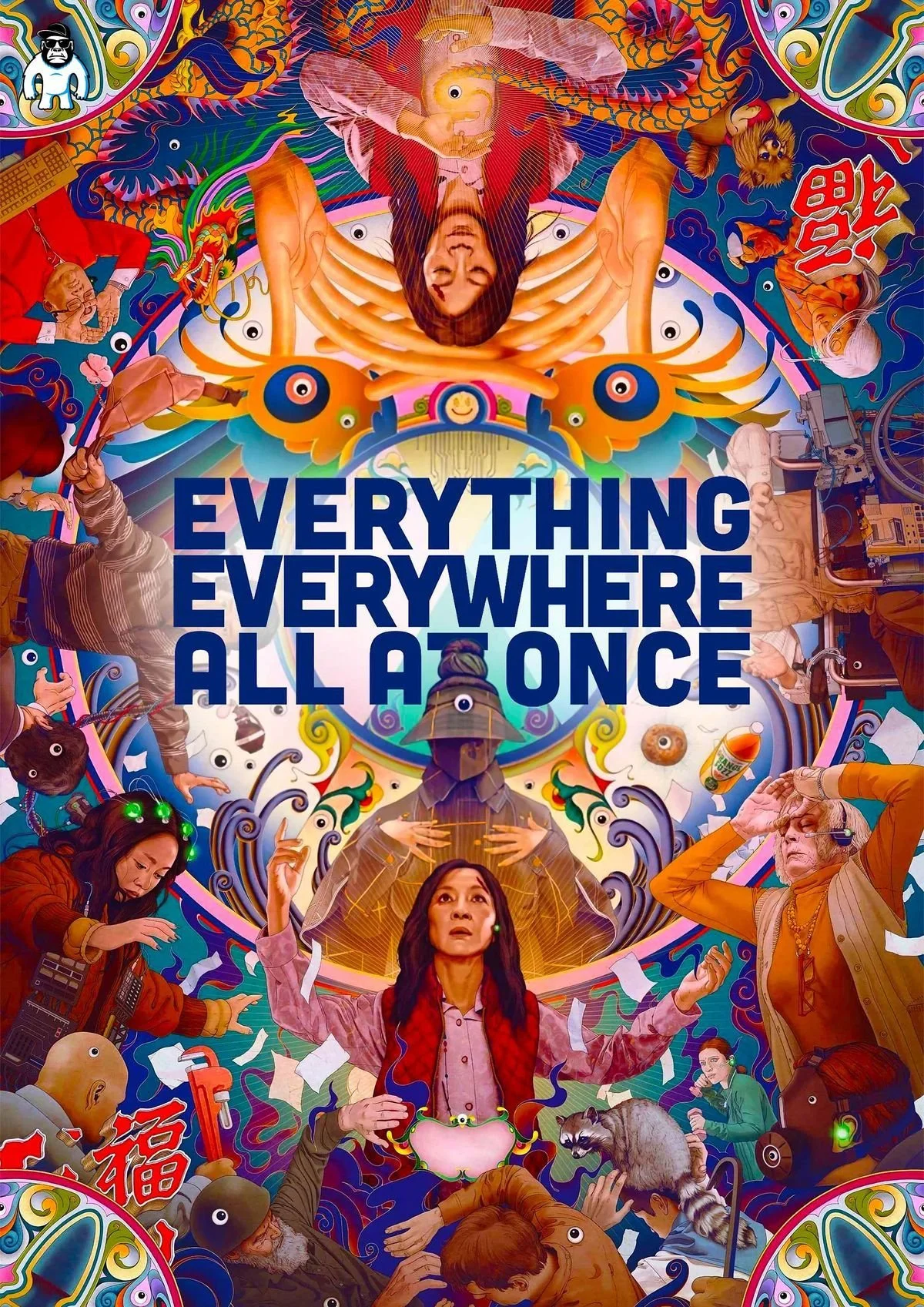
Movie poster ‘Everything Everywhere All at once’, Dan Kwan & Daniel Scheinert, 2022.
High+ Giftedness is not only cognitive. It is often experiential. The world enters the individual with force. Ideas, impressions, emotions, moral tensions, sensory signals, future scenarios, symbolic meanings and existential questions may all arrive at high volume. This can create vitality, creativity and depth. It can also create overload.
A High+ Gifted person may experience life as too much and not enough at the same time.
Too much input. Not enough meaning.
Too much intensity. Not enough form.
Too much potential. Not enough manifestation.
This combination is difficult to live with. The person may feel called by possibilities that cannot all be realized. Every choice becomes a loss of other possible lives. Every creation is both relief and disappointment. Every concrete result is smaller than the inner image from which it came. That gap can hurt.
Not because the person is ungrateful. Not because they are spoiled. Not because they need to “learn to be realistic.” But because their inner field of potential is unusually large, and the translation into ordinary time, ordinary work and ordinary life is inherently limiting.
This is one of the central developmental tasks for High+ Gifted people: learning to live with intensity without being consumed by it. They need grounding, but not flattening. Containment, but not suppression. Embodiment, but not domestication.
A High+ Gifted person who is forced to become normal may become depressed, cynical, fragmented or self-destructive. A High+ Gifted person who learns to contain their intensity can become unusually creative, perceptive and generative. The question is not how to reduce the fire. The question is how to build a vessel strong enough to carry it and handle the high compression that comes with it.
5. Self-image and perfectionism: the problem of inadequate mirroring
Gifted people can struggle with perfectionism. High+ Gifted people may struggle with something deeper: the inability to find an adequate mirror for the full scale of who they are. Success may not solve this. Praise may not solve this. Achievement may not solve this.
A High+ Gifted person may accomplish something impressive and still feel: this is not it. This does not yet match the inner standard. This does not yet express the whole. This is merely a fragment. From the outside, this can look like dissatisfaction or arrogance. From the inside, it may feel like grief.
The person knows, senses or intuits a larger possibility than the one currently expressed. They may not be able to name it, but they feel its pressure. This can lead to imposter syndrome, chronic self-doubt, perfectionism, nihilism or a refusal to finish and share work. The external world rarely reflects them accurately. It may praise what was easy and ignore what was essential. It may reward performance and miss depth. It may value output and overlook the inner developmental movement behind it.
For High+ Gifted people, creating is therefore not only about producing something useful. Creation becomes a way to perceive themselves. They make something and the thing looks back. Through that feedback, they gradually discover the architecture of their own consciousness.
This is why it is so important to help High+ Gifted people bring their work, ideas and creations into the world. Not prematurely. Not carelessly. But concretely enough that their inner world gains form, friction and reflection. Without manifestation, the inner matrix can remain private brilliance. With manifestation, it can become development. Individually and collectively.

© The Mind Matrix, Dirk Anton van Mulligen, 2025.
Enter the Mind Matrix
The concept that best captures this inner architecture is the Mind Matrix, a term coined by Jennifer Harvey Sallin in her excellent article ‘High, Exceptional and Profound Giftedness’ (see: Reference). A Mind Matrix is a self-constructed network of associations, meta-links, analogies, patterns, distinctions, knowledge, memories, images, questions and frameworks through which a gifted mind makes sense of complexity.
Everyone has associations but not everyone builds a matrix. In High+ Gifted people, this matrix can become highly complex, autonomous and self-expanding. It does not merely store information. It contextualizes experience. It links domains. It searches for underlying structure and meta-analogies. It creates meaning and coherence across levels.
This explains why High+ Gifted people can seem impossible to follow. They are not always moving from A to B. They may be moving from A to the hidden principle beneath A, then to an analogy in another field, then to a future implication, then back to B with a conclusion that feels obvious to them and sudden to everyone else. And this all happens in an instant.
When the Mind Matrix is healthy, it is a source of insight, creativity and orientation. When it is unsupported, it can become a source of overload, isolation and fragmentation.
This is why High+ Gifted people do not only need information, stimulation or challenge. They need matrix space: enough room to think, connect, test, question, synthesize and integrate. They need autonomy, meta-frameworks and a conscious environment. They need people who can enter the logic of the matrix without immediately trying to simplify it. A follow-up blog will focus entirely on the Mind Matrix, because it deserves its own treatment.
For now, the essential point is this:
High+ Giftedness is not just a higher score, it is often a different architecture of sense-making.
And different architecture requires different terrain to build upon.
A High+ Gifted person can fail in the wrong terrain while being entirely capable of flourishing in the right one.
Beyond creation: integration as the real developmental task

The Evolved Self, © Dirk Anton van Mulligen, 2025.
Many educational and professional models treat creation as the highest level of learning. To understand, apply, analyze, evaluate and finally create: that is already a rich developmental arc. For High+ Gifted people, creation is not always the best endpoint. Often it is a stepping stone.
They create something, and then the creation teaches them who they are becoming. The output becomes feedback. The idea, product, text, design, intervention, artwork or career move becomes a mirror in the larger development of the Self.
This is why I see integration as a necessary next level. Integration means that knowledge, experience, feeling, intuition, embodiment and creative output are gradually brought into coherence. It is not merely learning more. It is not merely making more. It is learning yourself whole; body included.
For High+ Gifted people, this may be the deepest task of all. Not simply to perform. Not simply to adapt. Not simply to achieve. Not even simply to create. But to become internally coherent enough that their intelligence, sensitivity, imagination, autonomy and contribution begin to operate as one living system. That is when giftedness becomes less of a burden and more of a field of contribution.
What High+ Gifted individuals need from parents, teachers, coaches, managers and organizations
The practical implications are clear.
1. Recognize the qualitative difference
Do not treat High+ Giftedness as “more of the same.” These individuals often need different ecosystems, not merely more difficult assignments.
2. Normalize asynchronous development
A young, and sometimes not so young anymore, person may think like a researcher, feel like a poet, react like a child and question like a philosopher. That does not make them broken. It means development is uneven and needs intelligent support over time. A long time.
3. Offer psychological safety for intensity
Existential questions, moral urgency, non-conformism, sensitivity and unusual associations need a space where they are not immediately pathologized. Without such space, intensity may turn inward.
4. Give autonomy with structure
High+ Gifted people need ownership. But ownership does not mean chaos. The right structure protects freedom instead of replacing it.
5. Find mentors and partial peers
One well-matched mentor or partial peer can do more than years of generic guidance. The key is resonance combined with developmental maturity.
6. Redefine success
For many gifted people, success means acknowledged achievement in society. For High+ Gifted people, success often has to include personal integration: the ability to live, work, love and create without burning out, disappearing or betraying the core Self.
“The highly and profoundly gifted do not merely march to the beat of a different drum, they hear the drum itself differently. Where others move to rhythm, they listen for resonance; they sense the pulse beneath the audible, the silence between the strikes.
For them, life is not a parade to join but a highly personal symphony to compose while going through life. Each step carries echoes of unseen harmonies, intellectual, emotional & spiritual, that call them both inward and outward at once. They live in shifting time signatures, aware of patterns others do not perceive, moved by questions that have no apparent cadence.
To the world, their rhythm may seem restless or strange. To them, conformity sounds like silence, torture or even death. And yet, when they find another who hears that same unearthly measure, their steps align. Not in uniformity, but in shared wonder. Then the music of existence reveals itself: wild, intricate, beautiful and achingly true.
Suddenly the meaning of life becomes crystal clear.”
— The March of the Highly and Profoundly Gifted by Dirk Anton van Mulligen, 2025.
Marching to a different drum
High+ Gifted people do not merely march to the beat of a different drum, they hear the drum itself differently. Where others hear rhythm, they may hear resonance. Where others see a task, they may see a system. Where others accept the frame, they may question the reality that produced the frame. Where others look for a path, they may be trying to understand the terrain.
This can make them difficult but can also make them invaluable. Especially in a world that increasingly needs people who can think across systems, detect weak signals, create new frameworks, question inherited assumptions and bring future possibilities into form. But this will not happen by forcing High+ Gifted people to become more normal. It will happen by helping them become more integrated.
Their task is not to adapt themselves out of existence. Their task is to find, build and inhabit the kind of terrain in which their intelligence can become contribution. That is where the real work begins.
And that is also where Your Evolving Self does its work: not by reducing giftedness to performance, but by helping gifted people understand their inner architecture, shape their outer field, and create a life and career that can actually hold who they are.
The follow-up blog will explore the Mind Matrix in more depth: the hidden architecture through which High+ Gifted minds build worlds of meaning.
Dirk Anton van Mulligen
Your Evolving Self — exploring giftedness, development, and the art of guiding exceptional minds.
The ideas in this article are part of what I am currently working on and are drawn directly from the people and challenges I encounter in my practice. I am in the process of writing two books:
1. The Gifted Hunter a foundational work on leadership and innovation under complexity, focused on the role of gifted, highly capable individuals who operate at the edge of existing systems and carry responsibility for renewal when stable structures begin to fail.
2. Your Evolving Self, a Career Development Guide for Gifted Professionals.
© Dirk Anton van Mulligen, Your Evolving Self, 2026.
Please note: This article is the result of regular and long reflection on this matter, supplemented with my experiences with gifted people. In other words, I put a lot of time and energy into it. No part of this article may therefore be reproduced without acknowledging the source and the author. If you want to use more than a single quote or insight, please contact me for permission.
Reference:
Harvey Sallin, J. (2020). High, Exceptional and Profound Giftedness.
